

When someone sees a bottle of fiber sitting on someone’s desk, the first thought is that the person taking fiber needs help with their bowel movements, and the first observation is that they may be old. If the latter proves to not be true however, then a joke about constipation comes up. It goes without fail, I’ve been made fun of for consuming fiber, it always happens. But the thing is that people don’t realize that fiber is a necessary part of our diets and with how much processed foods we typically consume on a daily basis, our bodies are not getting enough fiber to break them down and properly digest them. It’s time we spread awareness!
On average, the daily intake of dietary fiber may approximately be 15 grams per day, but the actual recommended amount ranges between 25 to 40 grams per day.
Per the Institute of Medicine:
- Men and women younger age 50 years or younger should consume 38 and 25 grams of fiber respectively
- Men and women age 51 years or older should consume slightly less – at 30 grams and 21 grams for men and women respectively
Considering the amount of processed food we tend to consume on a daily basis, it is safe to say that some of us may get anywhere from eight to 15 grams of fiber on a good day. This alone could help us understand why we feel bloated, gassy, overweight, with low energy levels especially when 2 o’clock hits. Unfortunately, low fiber consumption can also lead to other health-related problems, such as heart disease, type 2 diabetes, breast cancer, and even Diverticular disease. At this time, fiber has minimal known effect on colon cancer risks, but it is currently being researched.
Dietary fiber comes in two varieties:
- Insoluble fiber – This type of fiber does not dissolve in liquids. It may assist with moving food through your digestive system, and with regularity as well as prevent constipation.
- Soluble fiber – This type of fiber does dissolve in liquids and may help with lowering glucose levels, as well as blood cholesterol levels.
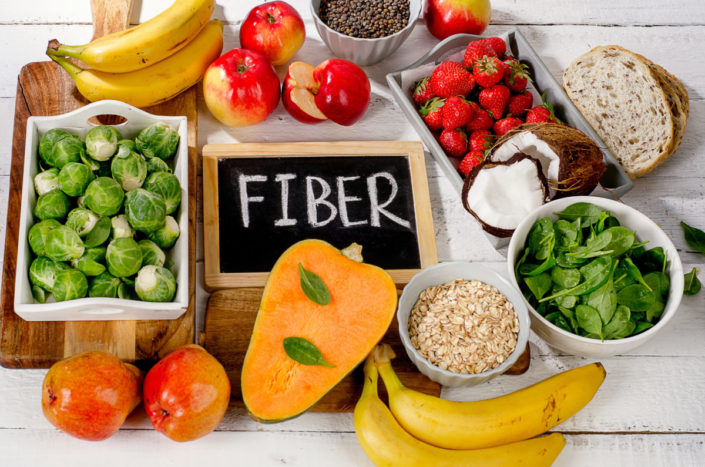
Dietary fiber is primarily found in many fruits, vegetables, legumes, nuts, seeds, and whole grains. It can also be supplemented through a variety of different forms, but keep in mind that it may not be a complete fiber source when compared to a whole food source. As previously mentioned, fiber possesses many unique and special abilities that are not just limited to relieving constipation but can also provide a whole array of different benefits as well.
The benefits of a high fiber diet include, but is not limited to:
- Control glucose levels – In people with diabetes, soluble fiber has shown to slow the absorption of sugar, thus improving their blood sugar levels. Also, when lunchtime rolls around, if your meal includes fiber, it may help with the 2 o’clock crash feeling we get! It does this in the same fashion that those with diabetes experience.
- Lower cholesterol levels – By lowering “low-density lipoprotein,” otherwise known as LDL (bad) cholesterol levels, soluble fiber helps with lowering total blood cholesterol levels.
- Heart-health – Fiber helps by reducing blood pressure and inflammation.
- Regulate bowel movements – Fiber helps increase the weight and size of your stool while softening it. A bulky stool is much easier to pass, which also helps in decreasing constipation. If you experience loose, watery stools, fiber may also help by solidifying it through water absorption, thereby adding bulk to your stool.
- Maintain health bowel movements – A high-fiber diet may decrease your risk of developing hemorrhoids and other small pouches in your colon (diverticular disease), as some fiber is found to ferment in the colon. This could be great news for those with colon disease, but research is still underway.
- Weight loss – Because high-fiber foods are more filling than low-fiber foods, you’re likely to eat less and stay full longer. High-fiber foods are also a good way to consume a lot more while maintaining your total caloric intake low. This is great for those that choose to follow a low carbohydrate diet since fiber is not counted as part of your total carbohydrate macro intake.
- Maintain a healthy weight – As previously mentioned, fiber helps with weight loss by allowing you to eat less and feel full longer. As a result, you’re also likely to continue maintaining your goal weight!
But wait, how can we increase our fiber intake?
Although it is best to consume fiber through whole foods (vegetables, legumes, nuts, fruits, whole grains, etc), sometimes we aren’t able to constantly spend too much at the grocery store, and/or we are too busy living and working, that replenishing our refrigerators on a daily to weekly basis may seem almost impossible. This is especially true in those that say, “I can’t cook my meals at home because I’m always busy! I commute too far, I work too much” and etc.
Fiber supplements are readily available and have no harmful effects. Fiber comes in many different forms such as:
- Capsules
- Powder
- Chewables
- Cereal
- Fiber bars
- Flaxseed
You can take a trip to your local convenience store or supplement shop and pick up a bottle of Psyllium Husk, Metamucil, or Citrucel, just to name a few (these come in capsule and powder form). One supplement of choice that I take regularly is Metamucil. I use Metamucil twice a day in order to supplement my fiber intake. I take one to two tsp first thing in the morning, 30 minutes before my first meal, and an hour before going to bed. Metamucil can also be found at Target, Walmart, or any other convenience store near you. Flaxseed is also a great fiber source, but it is also excellent in that it provides you with Omega-3 essential fatty acids, otherwise known as GOOD fats. Omega-3 essential fatty acids may provide great benefits that help with your brain, heart, mood/hormones, and etc (this will be covered on another post).
Should I just go ahead and start eating all the fiber I can get?
Unfortunately no, this will be a process that you’ll have to slowly build up to. If you’re not used to consciously consuming fiber (noting how much fiber you’ve taken throughout the day), you’ll want to start small in order to prepare your body’s digestive tract. As you increase fiber, your digestive tract has to begin adapting to the increased fiber, thus processing it more efficiently. Otherwise if you bombard it, you’ll experience major abdominal discomfort (constipation, bloating, gas, etc).
The way I went about increasing my fiber (USING METAMUCIL PACKETS) went like this:
- Week one: One tsp every other day
- Week two: One tsp every day
- Week three: One tsp twice a day (morning and evening)
- Week four: Two tsp twice a day (morning and evening)
- Week five+: Adjust as needed
Everyone may go about this differently. Unfortunately because I have IBS, I had to take the longer route. Many may just begin adding one tsp of their fiber supplement and they’ll be fine, slowly increasing their intake. However that was not the case for me.
If you’re not supplementing your fiber intake but acquiring it from whole foods (good for you, this is fantastic, seriously) then you can begin by slowly increasing what you’re eating. One apple a day turns into two, 1/4 cup of beans turns to 1/2, and so on. Although it is difficult to track how much fiber you consume on a daily basis, if you can try to keep tabs on it (even if only for a week). Use My Fitness Pal to track your fiber intake (and your macros, what you’re eating, etc) so you can proactively see how your body adjusts, reacts, adapts, and just how much fiber you’ll need going forward. As you get used to consuming fiber, you won’t need to constantly check how many grams you need per meal, or how much you have left to consume.
In time, you’ll be on your way to feeling great with regular bowel movements, more energy, increase productivity, and an overall great sense of well-being.
Water intake
Because fiber absorbs liquid, your water intake will have to increase. The average American drinks two to three cups of water (24 oz) total. This will need to significantly increase (considering we should already be consuming eight eight-ounce glasses of water) so that fiber can function properly in your digestive tract, AND you don’t end up gassy, bloated, or have any other abdominal discomfort.
 liveestronger.com
Leave a comment