

This will be part ONE of my fat loss article as experienced by me, which covers what has worked for me.
It has been quite an interesting winter so far, with a snowstorm that swept the east coast that left many of states paralyzed with snow and frozen with fear, to the Broncos taking the Super Bowl 50, and now, another potential snowstorm that is on the way. During winter like these, it is natural for people to sit back by the fire, relax, warm up some hot chocolate, and engorge on amazing and delicious meals.
Why wouldn’t we do this? It’s natural tendency for all humans to want to devour heaps of ice cream, hot pockets, pizza, wings, and especially alcohol. There isn’t anything else to do during a snow day, other than to sit by the TV and relax all day, sleep all night. Eating like this has a major price, however. Sure, you’ll feel great with every bite you take, you’ll feel comfortable, you’ll fill yourself back up after you get hungry again. But with all of this, comes a price. Aside from looking at it from a superficial standpoint, the health concerns that may come with what negative choices you make, may creep up on you if they’re left ignored. And lettuce be cereal, we can’t stop eating junk food after the first donut, or the first cup of ice cream. Some of us have no control over how much we ravage when we take that first bite.
But, what if you could eat like a king, yet lose weight and get shredded? It’s possible.
Before I continue, I want to make it known: CUTTING means to lose weight, burn body fat, and become “toned” for the ladies, and “shredded” for the men. BULKING means to purposely gain weight in pursuit of gaining muscle and increasing lean body mass.
Now, I have gone through many different diet methods in the past eight years that I have been an active lifter, from eating seven to eight times a day, to eating three big meals, to intermittent fasting (eating two big meals spaced X amount of time apart), to If It Fits Your Macros (which actually does work IF you actually abide by it like you’re supposed to).
Early 2015. The heaviest I believe I have ever reached is 260. At the time, 260 felt great, I was lifting heavy with zero potential for injury (proper form, and proper nutrition), but I knew for a fact that it wasn’t all muscle, it was mainly fat. I did what’s called a “dirty” or “dreamer” bulk, in which you eat anything and everything you want without giving the consequences any mind. What I experienced, was constant bloating from every meal I’d eat, whenever I’d drink WATER, I’d burp, my energy levels weren’t at their best, and I definitely felt it in the way I’d roll around on the bed, in my joints, and every where else. I was overweight. I kept using lifting and “bulking” as my excuse, but needless to say, I needed to make a change.
I gave intermittent a try, and tailored it to work with my schedule since it provides this type of flexibility. IF utilizes an approach in which you fast for a certain amount of hours, and eat two to three meals (depending on how you want to do this), before fasting again. I used the 16 hour fast, 8 hour eating window approach. I fasted from 8PM until 12PM the next day, ate a big meal (Chipotle size, 800-1200 calories), had my workout and had the second half of my meal which filled up the rest of my caloric intake). This worked MAGIC, because my body immediately started releasing all the water weight I had also gained from bulking. My energy levels shot through the roof, I began feeling great, and I started losing weight as well as burning fat. I felt great. Eventually I stopped using this approach just because I felt I need to change things up. I gave IF a good run, but I realized that I started coming off the tracks with it and started getting dumb with my diet.
February 2016. A year later, I finally decided to SERIOUSLY embark on a true diet regimen, one that I was going to tailor for myself once again, and ensure accuracy of meals, as well as deliciousness. I get bored with everything rather quickly, so I have to keep changing things up in order to maintain my own interest, and I also have to have flavor. Otherwise I’ll quickly toss it out.
I found the below image and it reminded me of what I once used to do back in the day when I got myself down to my goal weight of 185! This was about five years ago. It’s TIME to give this a true shot.
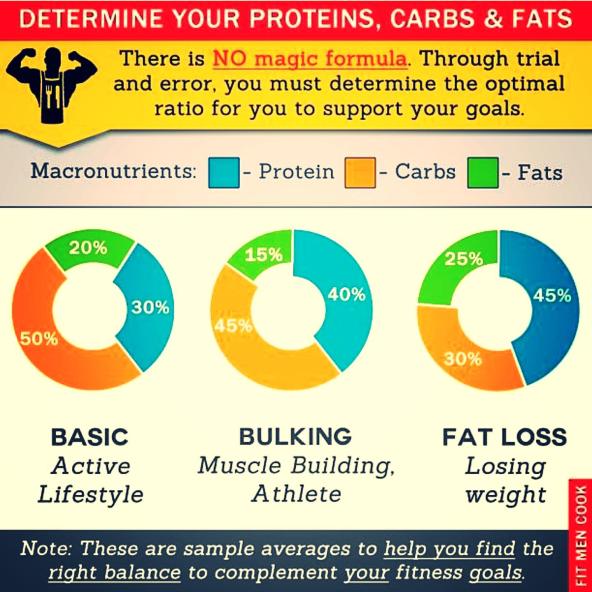
The approach I have taken, is 45% protein, 35% carbs, 20% fat. I was initially cutting on 1750 calories, but I was starving by the end of the night, that I couldn’t keep up with it. So I adjusted my calories to 2000 total, and ever since last week, I have been feeling different, clothes have been feeling different, losing weight has been possible, and so far everything has been going well. I started at 236, and a week later, I’m down to 227.
I have been eating like a king, see my meals on my fitness pal.
So what do these percentage breakdowns correspond to? Glad you asked.
Depending on the approach you’d like to take, which you’ll actually learn is A LOT of trial and error, you can either go for a balanced caloric intake of carbs, fats, and proteins, or you can favor one more than the other.
Typically if you’re CUTTING, you’ll favor a higher protein, moderate carb, and low fat approach. If you’re BULKING, you may opt for higher carb, moderate protein, low fat (especially if you’re looking to lean bulk), or you could also do a low carb, high fat, high protein. Otherwise, if you’re MAINTAINING, you’ll go for a equal carb/protein, low to moderate fat intake.
This is separate from keto dieting, in which you eat llloowww carb, but maintain your fat intake at a high level alongside protein. This is a great approach for dropping weight rather quickly, but I have not tried it yet so I cannot vouch for it. However, many people have had successes on it. More information found here!
The per cents correspond to the amount of protein, carbs, and fats you’ll eat.
Recall:
1 gram of carbohydrates = four calories
1 gram of protein = four calories
1 gram of alcohol = seven calories
1 gram of fat = nine calories
Therefore, if we take my percentage separation into consideration (45/35/20), it’ll look something like this:
2000 calories = 900 (calories from protein) + 700 (calories from carbohydrates) + 400 (calories from fat).
This was resolved by taking 45%, 35%, and 20% of the total 2000 calories respectively.
After about a week, you’ll be able to gauge if the approach you have selected is working for you. You should be experiencing a one to two pound weight loss per week, depending on just how much weight you have to lose. Keep in mind, the initial few pounds will be water, but this should still be enough to encourage you to continue!
My guidelines are as follow:
If you’re losing weight at a slow and steady pace, continue to cut at your selected caloric intake and percentage protocol.
If you find yourself gaining weight after a week, or two at most, consider lowering your calories by 100. Do not drop your calories substantially, your body KNOWS when you do this, and it will make it known. Slowly cut down 100 calories every week until you start to notice weight loss.
If you’re maintaining weight, take the same approach that you would if you’re gaining (if cutting is your goal).
Believe it or not, you may not need to introduce cardio just yet. I encourage you to adapt and adjust to your newly found way of eating, so your body can start molding itself over your new eating style. You can certainly perform cardio twice, to three times a week if you’d like when you start dieting, that will not hurt you. I’d suggest performing three 15 minute sessions, or even three 20 minute sessions a week, just to get your body into the thermogenic mode to begin burning fat, as well as for heart health. Once you start getting accustomed to cardio and your diet, you can begin by adding a HIT session to speed up fat loss.
By maintaining a high intake of protein, you are constantly feeding your muscles and providing them the fuel they need to recover, repair, and grow.
Fat is required for proper hormonal balance, which is why I am against cutting fat by a lot, or even altogether. You need a healthy amount of fat (mono, poly, and some saturated) intake in your system to regulate many bodily functions, especially if you’re a male – as it does help with the male hormone, testosterone (Mercola, 2012). Fats also provide long lasting, and slow burning energy (monosaturated and polysaturated). Fat is a major component of a keto diet.
Carbohydrates are what fuel your energy levels and keep you leveled. Although they’re not mandatory, it is always good to have a proper amount of carbs in place in order to continually keep a healthy flow of energy. However, do be aware that there are differences between SIMPLE carbs (table sugar, gummy bears, brown potatoes, ice cream), and COMPLEX carbs (whole wheat bread, brown rice, sweet potatoes).
*Many people do manipulate carbs by “carb cycling” in order to get the best out of fat burning and weight loss, but more on that later.
With this breakdown of calories, which actually is more so macros, you’ll be able to make proper food choices and decisions that should fit your macros – hence where IIFYM came from. So long as you pick proper meals, or make your own proper meals, and you adjust them to fit your daily macros, you’ll be on your way to weight loss and shredded epicness.
 liveestronger.com
Leave a comment